Take Action with NeuroToggle®
The Foundation. The System. The Application.
Move from understanding how learning changes the brain to using NeuroToggle® to guide instruction.
Three connected resources take you from the science behind learning, to the NeuroToggle® instructional system, to practical application.
Three Resources · One Connected System
Choose the support you need next.
NeuroToggle® is organized as a progression from understanding the science, to learning the instructional system, to applying it with individual learners. Start with the resource that matches what you need to understand or do next.
The Foundation
Book 1
Understand the science
Start here if you want to understand neuroplasticity, neural circuits, learning, memory, neurodivergent relevance, and the teaching experiences that influence neural circuit development.
Book 1 → Book 2 → Toolkit
Start with Book 1 →The System
Book 2
Learn NeuroToggle®
Start here if you understand the foundations and want to learn the NeuroToggle® Learning Sequence, Teaching Sequence, and approach to aligning instruction with the development a learner needs.
Book 2 → Toolkit
Start with Book 2 →The Application
Educator Toolkit
Apply the system
Start here if you already understand the NeuroToggle® system and are ready to profile learner needs, support instructional decision-making, plan instruction, monitor progress, and refine application.
Book 2 + Toolkit
Get the Toolkit →Reader Reviews
What readers are saying.
Great book!
“This book is informative and consistent with the latest research on autism. I am an autistic professor who teaches neurodivergent students and I am always looking for great books to inform my teaching and this is definitely one.”
Good strategies for teaching neurodivergent children
“Was worried it was going to be hard to read. Was pleasantly surprised. Simple and straightforward sections on helping to teach my autistic child. Wish I had it sooner. Great work.”
Yes!
“This is it! Neuroplasticity is key. My daughter is doing great! This book is well written and accessible.”
Amazing work!
“It is so helpful I love it!! I have a family and we are a mix of AuDHDers. I’ve only read a few pages here and there so far, but it’s helped me at home and as an RBT.”
The Foundation
Book 1
Learn the science behind learning and the teaching experiences that influence neural circuit development.

NeuroToggle® · Book 1
Book 1 establishes the neuroplasticity foundation for NeuroToggle®. It explains how learning and memory emerge through changes in neural circuits, why those mechanisms matter for neurodivergent learners, and how teaching experiences can be understood through a neuroplasticity-informed lens.
Explore:
- Neuroplasticity and neural circuits: how experience changes pathways supporting skills and behavior.
- Learning, memory, and neurodivergent relevance: why access, consistency, flexibility, and retention may differ.
- Neuroplasticity-informed teaching: experiences that support meaningful learning and development.
The System
Book 2
Learn how NeuroToggle® connects neural circuit development to instructional decision-making.
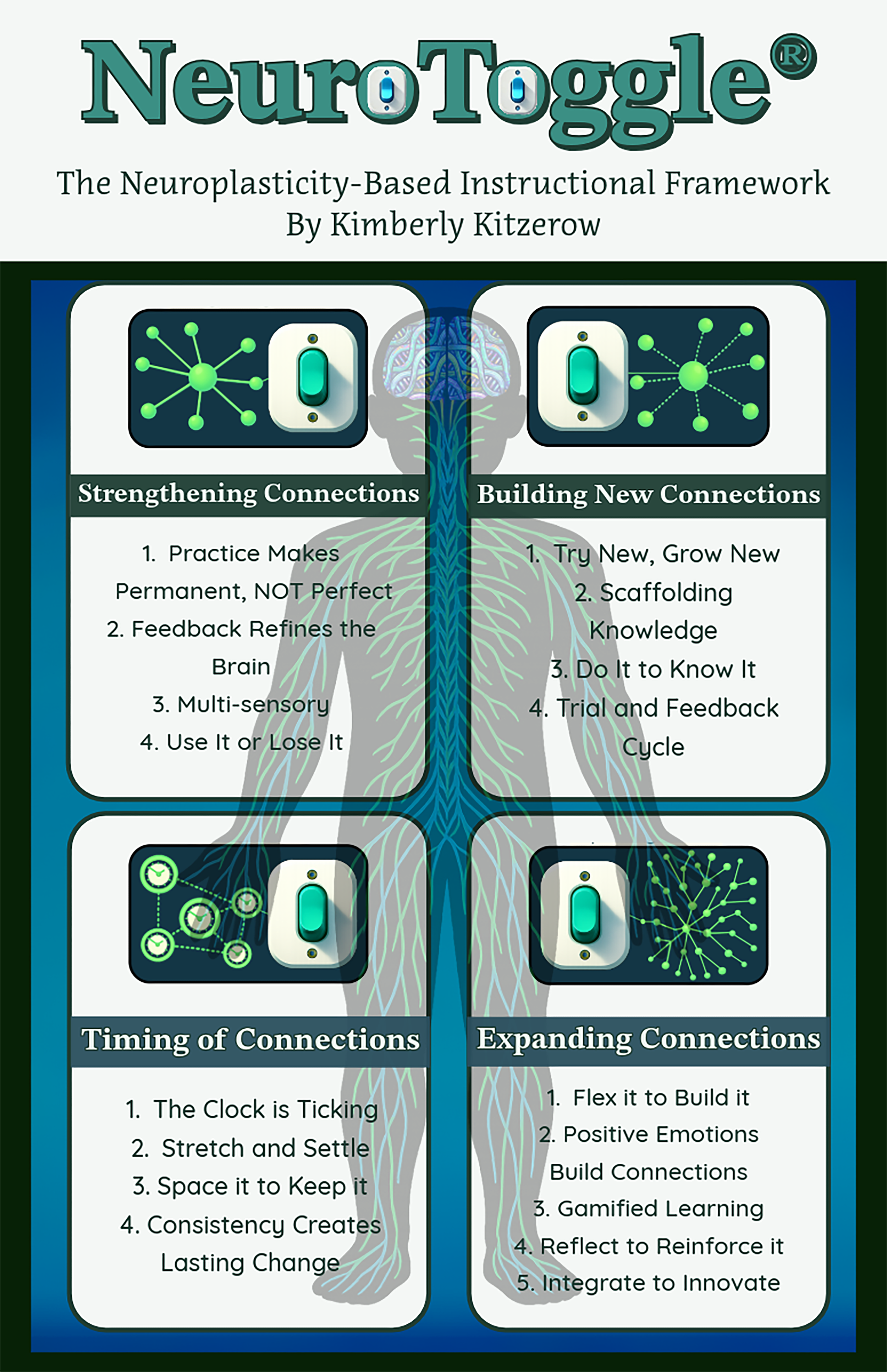
NeuroToggle® · Book 2
Book 2 presents the NeuroToggle® instructional system. Its Learning Sequence distinguishes whether a skill needs to be Built, Strengthened, Expanded, or Timed. Its Teaching Sequence guides educators to Identify, Define, Apply, and Refine while maintaining instructional alignment.
Explore:
- The Learning Sequence: Built, Strengthened, Expanded, and Timed.
- The Teaching Sequence: Identify, Define, Apply, and Refine.
- Instructional alignment: matching teaching strategies with the learner’s current need.
The Application
Educator Toolkit
Move from understanding the NeuroToggle® system to applying it in educational practice.

NeuroToggle® Educator Toolkit
The Educator Toolkit turns NeuroToggle® into a practical process. The Skill Growth Profile, Decision Guide, and Planning Worksheet support instructional planning and monitoring. The Behavior Replacement Worksheet provides Replace as a separate pathway when a preferred response must be developed.
Explore:
- Profile and decide: clarify the learner’s current level and developmental need.
- Plan and implement: organize aligned instruction and practical next steps.
- Replace, monitor, and refine: develop preferred responses and adjust from learner response.
NeuroToggle® in Use
Examples of application.
Select an example to see how the framework can organize support around a learner’s current need.
Family Applications
Building skills and behaviors at home
If a child is not speaking or has limited speech
Speech depends on sensory, processing, motor, breathing, coordination, and communication pathways working together.
Build
Target joint attention, imitation, facial movement, gestures, breath, and sound attempts.
Strengthen
Repeat meaningful learning experiences so speech-related pathways become reliable.
Time
Support the timing and coordination involved in processing and producing communication.
Expand
Pair movement, language, interaction, AAC, and opportunities for initiation.
Move from joint attention to mirroring to increasingly independent communication.
If a child eats a very limited range of foods
Food variety can be approached as a gradual process of building tolerance, familiarity, and flexibility.
Build
Begin with looking at, tolerating, touching, smelling, or interacting with a food.
Strengthen
Repeat exposure so the experience becomes familiar and less effortful.
Time
Keep exposures consistent without pushing through too many steps at once.
Expand
Move outward using related textures, temperatures, colors, or flavors.
Tolerance may develop before touching, tasting, and consistent acceptance.
If a child struggles with back-and-forth conversation
Conversation develops from shared attention, processing, response timing, and repeated interaction.
Build
Start with shared attention, simple exchanges, imitation, and predictable turns.
Strengthen
Practice short back-and-forth exchanges within meaningful routines.
Time
Support the timing of receiving, processing, and producing communication.
Expand
Grow into longer responses, new topics, people, and settings.
Shared attention and turn-taking may need to become accessible before spontaneous conversation.
If a child needs a more functional replacement behavior
The preferred response should meet the same underlying need while providing a safer or more functional way to respond.
Establish
Teach a response such as requesting help, a break, or communication access.
Reinforce
Reinforce the preferred response immediately and consistently.
Prompt Early
Prompt the response before frustration or dysregulation fully escalates.
Generalize
Support the response across routines, people, environments, and independence levels.
Build communication access instead of focusing only on behavior suppression.
If a child is learning a new skill
A skill can be formed, reinforced, coordinated, retained, and made accessible across contexts.
Build
Break the skill into components and identify the earliest accessible step.
Strengthen
Use repeated practice until performance becomes reliable.
Time
Use sequence, spacing, repetition, and timing to support retention.
Expand
Move from supported performance to independent use across settings.
Develop the pathway until the skill becomes reliable, retained, and flexible.
Educator Applications
Using NeuroToggle® in educational practice
If a student is struggling with emotional regulation
Regulation can be treated as a skill developed through structured practice.
Build
Teach a calming routine, sensory support, movement break, or communication strategy.
Strengthen
Rehearse the routine during calm states so it becomes accessible under stress.
Time
Use the support at the first signs of dysregulation.
Expand
Generalize across transitions, classes, adults, and independence levels.
Teach one routine clearly, rehearse it while calm, and use it before demands escalate.
If a student needs a replacement behavior
The preferred response should meet the same function as the existing behavior.
Establish
Teach requesting help, asking for a break, using a visual cue, or accessing regulation.
Reinforce
Reinforce the replacement immediately and consistently.
Prompt Early
Prompt the response when the old behavior usually begins.
Generalize
Practice across people, tasks, settings, and independence levels.
Establish a functional alternative the student can use in real time.
If an ineffective behavior needs to be weakened
An old pathway may weaken as a functional competing pathway becomes stronger.
Establish
Build a functional competing response before reducing reliance on the old behavior.
Reinforce
Increase successful use of the preferred response.
Respond Early
Redirect before the existing response reaches full escalation.
Generalize
Maintain the preferred response across settings and context changes.
Weakening is gradual and depends on stronger use of a preferred pathway.
If a student needs stronger cross-modal retention
Multisensory teaching creates multiple ways to process and retrieve a concept.
Build
Introduce the concept through visuals, language, movement, touch, or manipulatives.
Strengthen
Use repeated multisensory practice so multiple routes support recall.
Time
Use spaced retrieval instead of relying only on same-day repetition.
Expand
Apply the concept in new formats and environments.
Pair a vocabulary word with a picture, rehearsal, gesture, and hands-on task.
If a student is struggling to engage with a task
Motivation, novelty, feedback, relevance, and accessibility influence engagement.
Build
Use novelty, scaffolding, clear entry points, and active participation.
Strengthen
Use immediate feedback, successful repetitions, and meaningful reinforcement.
Time
Alternate challenge with time to settle and process.
Expand
Connect tasks to interests, reflection, and broader applications.
Start smaller, clarify the entry point, and build success early.
Replace is a separate pathway. It is not an additional step in the standard Built, Strengthened, Expanded, and Timed Learning Sequence.
Compare the Resources
Find what you need.
| Resource | Book 1 | Book 2 | Educator Toolkit |
|---|---|---|---|
| Role | The Foundation | The System | The Application |
| Focus | Neuroplasticity, neural circuits, learning, memory, neurodivergent relevance, and teaching | Learning Sequence, Teaching Sequence, and instructional alignment | Learner profiling, planning, application, monitoring, and refinement |
| Use It To | Understand how learning changes the brain | Understand what development a learner needs and how instruction can support it | Apply the NeuroToggle® system with an individual learner |
| Includes | Neuroplasticity principles and neuroplasticity-informed teaching strategies | Built, Strengthened, Expanded, Timed and Identify, Define, Apply, Refine | Skill Growth Profile, Decision Guide, Planning Worksheet, Behavior Replacement Worksheet, and monitoring supports |
| Best Starting Point | New to the science | Ready to learn the system | Already understand the system and are ready to apply it |
| Explore | Book 1 → | Book 2 → | Toolkit → |