Teaching based on how the brain learns.
NeuroToggle®
Learning changes the brain. But how?
Teaching strategies matched to the neural circuit changes needed for learning and retention.
What readers are saying
Used by professionals, educators, parents, and neurodivergents.
★★★★★
Great book!
“This book is informative and consistent with the latest research on autism. I am an autistic professor who teaches neurodivergent students and I am always looking for great books to inform my teaching and this is definitely one.”
★★★★★
Good strategies for teaching neurodivergent children
“Was worried it was going to be hard to read. Was pleasantly surprised. Simple and straightforward sections on helping to teach my autistic child. Wish I had it sooner. Great work.”
★★★★★
Yes!
“This is it! Neuroplasticity is key. My daughter is doing great! This book is well written and accessible.”
★★★★★
Amazing work!
“It is so helpful I love it!! I have a family and we are a mix of AuDHDers. Ive only read a few pages here and there so far. But it’s helped me in home and as an RBT.”
What is NeuroToggle®?
Teaching strategy meets neural circuit development.
Skills and behaviors are produced through neural circuits. As we learn, those circuits change.
NeuroToggle® is a system for teaching based on how the brain learns, matching teaching strategies to the specific ways in which they change neural circuits.
This process matters for all learners, but it is especially relevant for neurodivergent learners, whose different patterns of neural circuit development can affect how skills and behaviors develop and how learning occurs.
NeuroToggle connects the science of neural development and learning to the teaching strategies used to support it.
Learn NeuroToggle®
Understand the science.
Learn the system. Apply it.
Three connected resources take educators from foundation to implementation.

Foundation · Book 1
Neuroplasticity Principles
Begin with the science behind the system. This foundation introduces the neuroplasticity concepts that shape learning, memory, and neural circuit development—so educators can understand why different teaching approaches produce different kinds of change.
Explore the foundation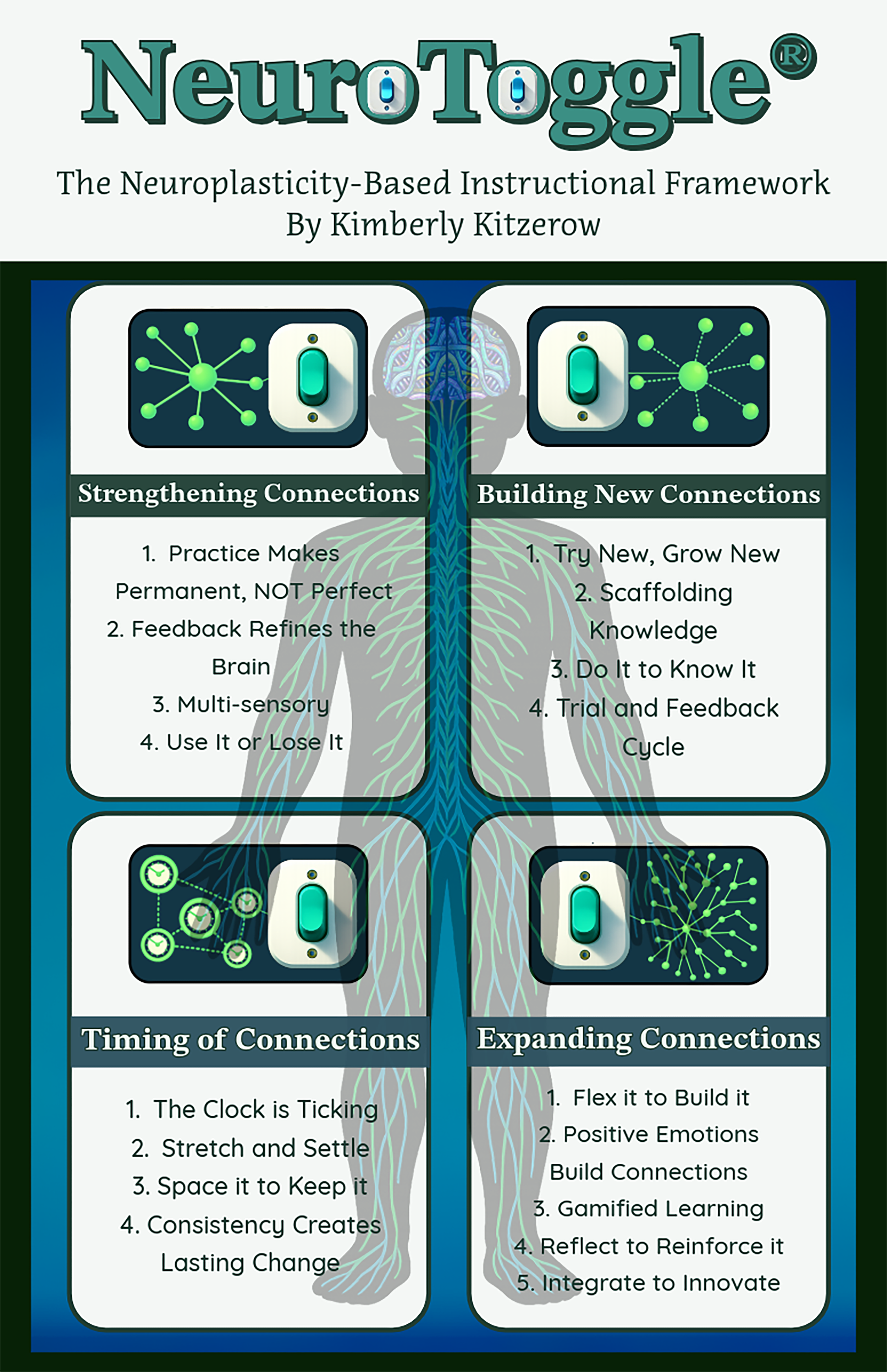
System · Book 2
The NeuroToggle® System
Learn the complete instructional framework for developing skills and behaviors. The system connects teaching strategy to the neural circuit changes involved in building, strengthening, expanding, and timing learning.
Explore the system
Implementation · Educator ToolKit
Put NeuroToggle® Into Practice
Move from understanding to application with practical, ready-to-use resources that help educators identify the skill or behavior in focus, select aligned teaching strategies, and refine instruction based on learner response.
View the Educator ToolKitThe NeuroToggle® framework
One system. Two connected sequences.
The Teaching Sequence provides a process for applying NeuroToggle®. The Learning Sequence identifies the type of skill or behavior development instruction is intended to support.
Teaching Sequence
How the system is applied- 01IdentifySelect the skill or behavior in focus.
- 02DefineClarify the developmental goal.
- 03ApplyUse aligned NeuroToggle® teaching strategies.
- 04RefineAdjust instruction based on learner response.
Learning Sequence
Instructional Target- 01BuildThe learner does not have the skill yet.
- 02StrengthenThe learner can do it, but inconsistently.
- 03ExpandThe learner can do it in one context, but not others.
- 04TimeThe learner learns it, but does not retain or access it reliably.
- 05ReplaceAn ineffective or harmful behavior is meeting an underlying need.
Why it matters
Especially relevant for neurodivergent learners.
Neurodivergence involves differences in neural circuit development and function. Because neural circuits hold memories for producing skills and behaviors, those differences can affect how skills emerge, stabilize, generalize, and become accessible.
Skills and behaviors emerge through three types of circuits working together.
- Sensory CircuitsReceive information from the body and environment.
- Cognitive CircuitsProcess, organize, interpret, store, and connect information.
- Motor CircuitsProduce action through movement, speech, gestures, and responses.
Sensory, cognitive, and motor circuits work together to produce skills and behaviors.
Start with NeuroToggle®